

The opinion pieces and articles in major newspapers are coming fast and furious now…
HOW CAN WE SAVE THEATER?
In many ways, I’d wager most of the authors of these thangs, and theater makers didn’t have much foresight, or pragmatism during the pandemic to ask that question… and now, with regional theaters… and Broadway shows.. closing earlier than they should or completely shuttering, it’s a little late to even ask.
So, what went wrong?
I do think getting bailed out by the federal government during the pandemic was both a blessing and a….
Curse.
I know, that sounds weird.
First, here’s a smattering of the media alarm bells in the last few weeks, click on ‘em:
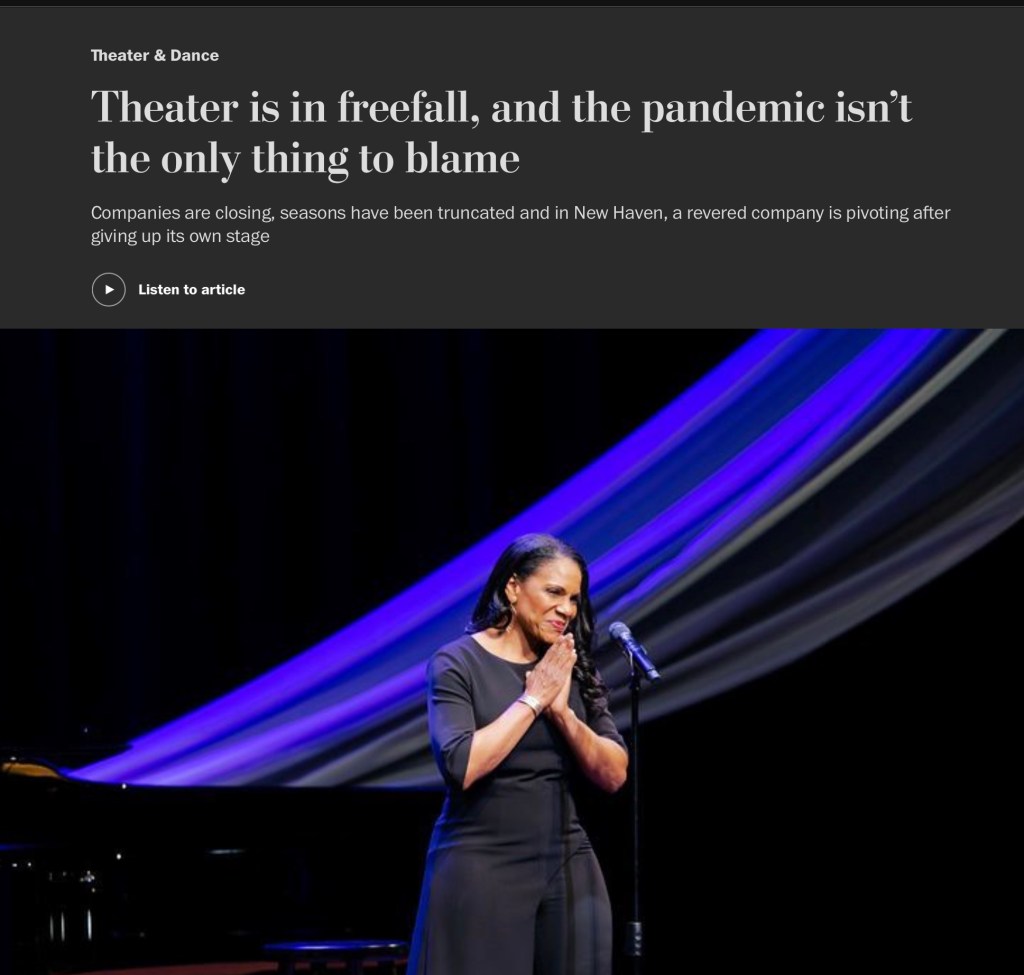
I’m saving my fave for later…
OK, obviously the blessing of pandemic relief was keeping the lights on in theaters while the world was being deluged with a deadly plague.
Artists and staff were able to stay afloat, not only with PPP loans but the Shuttered Venues Operating Grants to the tune of an additional 15 billion dollars in assistance.
The curse was keeping the lights on and staying afloat.
In that time of staying alive on the taxpayer’s nickel an awful lot changed.
Theater became black and white.
Whilst we were in our living rooms belting out show tunes on Facebook, the void of live theater left an opportunity to reshape, revise and “correct” theater.
By demand.

And that, my friends, will always be how we got here. If you look around, now ain’t too pretty.
When you.. or in this case We See You White American Theater…demand a mish mosh of a theatrical hostage checklist, there’s an implicit threat attached.
It’s not a negotiation. It’s not a discussion.
It’s a plain old takeover.
That will never be undone.
I’m not suggesting there aren’t other factors at play in the demise of American theater post pandemic…those include gross mismanagement, a falling subscription base and a glut of regional theaters.
But, I would think theater owners would consider the precarious state of the art and be compelled to be much more realistic, strategic and fiscally sane in preparing for the inevitable day the sun came out and live theater would return.
That’s not what happened:
“Kaiser, whose institute counsels hundreds of arts organizations across the country, believes that some theaters, motivated by honorable concerns about social and racial justice, pivoted in their programming too abruptly after the shutdown.
He called the move “a change of perspective in what stories they want to tell without necessarily bringing their audiences or their donors or their boards along with them, in a way that makes clear as to why this is important and how to participate and how to watch. And as a result, I think we’re seeing some serious loss of audience and board support and donor support.”
Washington Post
The pretzel twisting in that quote is astounding. In plain English, it’s an admission that theaters don’t really give a shit what audiences want to see, what their donors or boards or employees want to program, blithely treating theater goers as morons who need to be instructed in theatrical racial and social justice 101, and throwing in a guidebook for watching and participating in a show that costs a shit ton of money for a ticket.
I’m not sure the concerns are “honorable” frankly… and if you have to explain why your show is relevant then it’s probably not any good.
Theater transforms through feeling. Like on a stage.
How is blaming audiences and boards and donors honorable for the disaster that many theaters are facing?
A proverbial glance in the mirror would be really helpful in getting theater back on track. But that’s not gonna happen.. instead there will just be more articles about theater dying.

The cultish stranglehold is obvious… and so is the palpable backlash of branding audiences as dumb, conservative, racist, sexist, or homophobic if they don’t feel like checking out your skit.
This was one of the comments responding to one of these “ theater is dying” articles that struck me:
“When a theater in my area re-opened after the pandemic (and after the George Floyd protests of 2020) I happily returned to a place I had greatly enjoyed in the past. But what I found was a shockingly and utterly transformed institution, one that resembled a church more than a theater.
Upon walking in, I saw a “Land Acknowledgement” inscribed (permanently) on the wall. That acknowledgement, which reminded me of the cross one sees when entering a Christian church, informed us of prior native American inhabitants of the area, but essentially it seemed to serve as an ideological symbol.
Then I sat for the play, but, before it could begin, two theater representatives stood in front of the audience and spent 5-10 minutes reading from a prepared script admonishing us to be good anti-racists. You can’t make this stuff up. And this part of the service, I mean “play,” was more or less equivalent to a religious catechism.
Finally the play began, and the text of the play itself was fine, but that production was full of unnecessarily confusing “innovations” because just about every character was a different race. The problem is that the actual text of the play doesn’t support that kind of diversity; so, for example, there was no explanation provided for why a white woman and a black man had somehow given birth to an Asian child. In any other context, that sort of problem would be called a “plot hole,” but in the ideology of the DEI referenced in the above quote, it’s “progressive.”
I never went back to what hard once been a favorite theater. I wanted to attend a play, not a social justice sermon. I suspect that there is no longer any way to avoid the fact that a lot of theaters are going to close rather than change course. But new theaters will open, and I hope they will actually focus on theater.”
On the creative end, besides a racial edict of “no all white creative teams” (whatever that is), the magacal thinking has permeated the room and should have it’s own chair at the table.
Two of the biggest multi million dollar flops of this season on Broadway …one that’s closed and the other in trouble.. were based on pretty iconic movies.
They were new and improved and puréed into a state that even the willful suspension of disbelief couldn’t help.
Valiant efforts, but the mandated inclusion of inclusion of inclusion that whispered in the creative’s ears didn’t sell tickets.
The more stuff I read, almost on a daily basis, the more it seems to me a lot of the real damage is theatrical arson.
It’s either trying way, way too hard to appease a boogeyman, or just not giving a shit.
But, either way it burns.
The solutions to rescue an ailing industry are pretty rich, most of them invariably arrive at government bailouts or throwing more money at the problem.
What’s left unsaid in that scenario is the government already did.
How many times should the federal government rescue theater?
Until audiences see shows they’re just not interested in?
Ok, here’s my fave from the Washington Post:
https://www.washingtonpost.com/opinions/2023/08/09/how-to-save-american-theater/
For theater as we know it to have any future at all, a new economic model must take its place, founded on a simple principle: Fund artists directly. Then let the artists produce their own work, rent their own venues and pay their own collaborators.
WaPo opinion piece
This would be revolutionary. Consider that, during the covid-19 pandemic, when spaces were largely closed down, Milwaukee Rep, a midsize professional nonprofit theater, paid its artistic director $273,843 (out of a budget of $8 million), while the Public paid its director $888,676 (out of a budget of $37 million).
Magacal thinking in full splendor. Let’s just fund artists directly..with no administration. I’m surprised something so dense was published in the Washington Post.
There’s no connection to reality in that statement. But there is a growing contempt for artistic directors… a little research would show Oskar’s salary at the Public is very much in line with someone running a $40 million corporation.
Besides, he’s probably the only Artistic Director in the country to not actually give a shit about programming because he built a corporation that can afford to fund the 👀.
The Public is a commercial entity.. it’s a corporation that may be wearing a not for profit’s clothes, but it’s far from that.
A similar sitch is playing out with the SAG/AFTRA strike.. corporate monsters are responsible for the woes of the industry.. well, in some ways they are.
None of the burningitdown turns it’s attention to unions…which definitely share some of the blame for not keeping their eyes open and being proactive in addressing the many issues that have been around for decades.
“To put these numbers in perspective, I come from a background where we regularly put on plays for $10,000 to $15,000. We frequently sold out our runs — all three of my first plays in Durham, N.C., sold out, or nearly so. We always paid everyone something. Double that budget to $30,000, and we could have paid well. Extrapolate that into the millions, and hundreds of artists could have been writing and producing their own work — and paying their collaborators directly during quarantine.”
Speaking of unions, who on earth thinks they can pay union theater workers for a run of, well, more than a half hour for 30 grand?
How do you pay a general manager, a press rep, a marketing team and the myriad of other professionals it takes to create theater?
How about lawyers?
Professionals.
That’s the missing noun in this magacal fantasy.
That dream pretends that every theater professional lives in Barbieland.

It’s true that scaling down would mean prioritizing certain kinds of theater over others. But this is the case in every era: Some aesthetics thrive while others die out. Instead of a world in which you pay astronomical prices to see another tired revival from the mezzanine, imagine there are a dozen theater cells in your area, performing new work in backyards and parks and city squares and empty storefronts. Art that is fresh, fluid, immediate, accessible and affordable — to make and to see — all because we collectively decided to fund the artists directly. That’s the future I want. I can live without million-dollar rotating sets.
The future is putting on a show in your backyard. Actors Equity tried that in LA.
It’s still a disaster out there..that’s my quote.
The exhausted revivals the author poops on are the only shows consistently making money on Broadway currently.
Here’s the truth:
Everyone involved in theater wants their show to run. Everyone wants their dream to continue… from a Fringe Festival to Broadway.
Everyone who works in theater needs to get paid, because it’s a profession.
Every actor waits for that direct deposit to hit on Thursday.

The audience is crucial to that happening.
I remain hopeful for the future of American theater believe it or not.
And the Year of Magacal Thinking to be…
Last year.
Oh, there’s a thingy at the top of this blog to contribute to my WordPress subscription. If you like my blogs, please think about contributing.
Thank you so much.
.


 Robert DuSold
Leave a reply to Bobby Smith Cancel reply